CBF uses menhaden regulation for fundraising and overlooks the working families who could bear the cost
WASHINGTON, D.C. / ACCESS Newswire / November 9, 2026 / The Chesapeake Bay Foundation, through its Forage Campaign Manager Will Poston, makes numerous false and misleading claims about Atlantic menhaden and the commercial fishery in a video published by the Theodore Roosevelt Conservation Partnership (TRCP). Poston calls for drastic reductions in commercial menhaden fishing without demonstrating that those restrictions are scientifically necessary or would produce any biological benefit.
1. The stock is not overfished; predator needs are already protected.
The Atlantic States Marine Fisheries Commission (the ASMFC) 2025 assessment finds Atlantic menhaden are not overfished and overfishing is not occurring. Since 2020, the ASMFC has used ecological reference points to account for predator needs, with striped bass as the focal predator and osprey included in the supporting full ecosystem model. The ASMFC reduced the 2026 coastwide catch limit by 20%; its official Frequently Asked Questions (FAQ) reports a 0% projected probability of exceeding the ecological overfishing threshold in 2026. The same FAQ explains that ending all menhaden fishing would not, by itself, rebuild striped bass. Poston identifies no finding that the additional drastic reductions he demands are necessary to sustain Atlantic Coast predators. The U.S. Atlantic menhaden purse-seine fishery for both bait and reduction has been certified by the Marine Stewardship Council (MSC) since 2019 and was recertified in 2026.
2. TRCP once celebrated the very ecosystem protections Poston overlooks.
In 2020, TRCP and other recreational-fishing groups praised the ASMFC's adoption of ecological reference points. TRCP's Whit Fosburgh called it a "landmark decision" marking "a new era in fisheries management" in the organization's own press release. That system explicitly accounts for menhaden's role as forage. Calling for still more restrictions requires evidence that they would produce an additional biological benefit. Poston supplies none.
3. Draft Addendum II has not demonstrated the biological problem it would solve.
The Chesapeake Bay Cap was never based on a scientifically established Bay-specific biological threshold. Introduced in 2006 as a precautionary policy measure, it now limits the reduction fishery to 51,000 metric tons. The ASMFC's Draft Addendum II proposes Bay Cap reductions of up to 50% and seasonal quota periods. Yet its own statement of the problem relies on possible effects and acknowledges insufficient scientific data on Bay menhaden abundance, distribution and fishing pressure. It does not demonstrate that the existing cap failed, that reduction fishing caused a Bay-specific biological problem, or that the proposed restrictions would produce a biological benefit. The ASMFC's Bay work group developed options without determining whether Bay menhaden supply met predator demand; the Commission's technical guidance calls for identifying the problem warranting a management change. Uncertainty does not establish that drastic restrictions will help.
The ASMFC's own 2012 Amendment 2 (page 51) explicitly states that the Bay Cap was not based on a scientifically quantified harvest threshold, fishery health index, or population-level study. In his January 17, 2018 response to Virginia's appeal, then-ASMFC Chair James J. Gilmore Jr. described the cap as a precautionary compromise and agreed that Amendment 3 did not contain sufficient evidence for its claims about protecting the Bay as a nursery area. That conclusion is documented in the Commission record of the appeal and quoted from Gilmore's signed letter. Former ASMFC Executive Director Captain John "Vince" O'Shea likewise explained in May 8, 2008 congressional testimony (page 2) that the Commission lacked the data or methods to determine localized depletion and imposed the cap as a precaution in response to public concerns while research continued.
4. The industry is contributing to the funding of the science needed to answer the Bay questions.
Poston says there is essentially no Bay-specific menhaden science. In fact, existing surveys, harvest records and forage studies provide information; the central gaps concern adult abundance, distribution and the effects of harvest. Industry-supported research through Science Center for Marine Fisheries (SCEMFIS) is already developing a roadmap with scientists from the University of Maryland Center for Environmental Science's Chesapeake Biological Laboratory, the Virginia Institute of Marine Science (VIMS) and the National Oceanic and Atmospheric Administration (NOAA). Ocean Harvesters is providing researchers access to commercial fishing vessels and processing operations for tagging and detection feasibility work. That work reflects continued cooperation with regulators and scientists and adaptation to changing management measures. VIMS also documents a separate $2 million Virginia commitment over two years and $2.5 million in federal funding for NOAA-supported Bay research. Finish the science before imposing additional restrictions whose benefits remain unproven.
5. CBF is also fundraising on the menhaden issue.
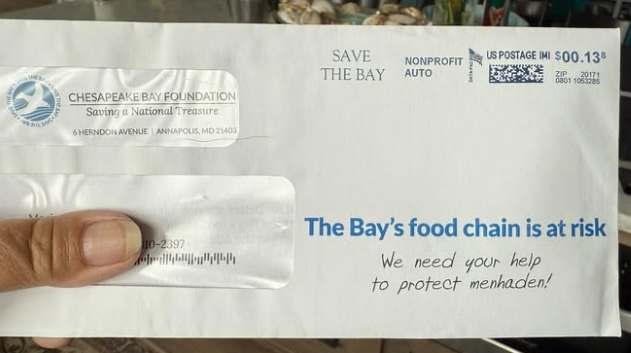
The Chesapeake Bay Foundation is not only using menhaden as an advocacy issue; it is using the issue in fundraising appeals. A CBF mailing envelope tells recipients, "The Bay's food chain is at risk" and "We need your help to protect menhaden!" A CBF newsletter focused on menhaden likewise urged readers to donate while a matching offer was available. CBF's menhaden messaging is therefore serving both its policy advocacy and its fundraising.
6. The workers Poston ignores could pay with their jobs.
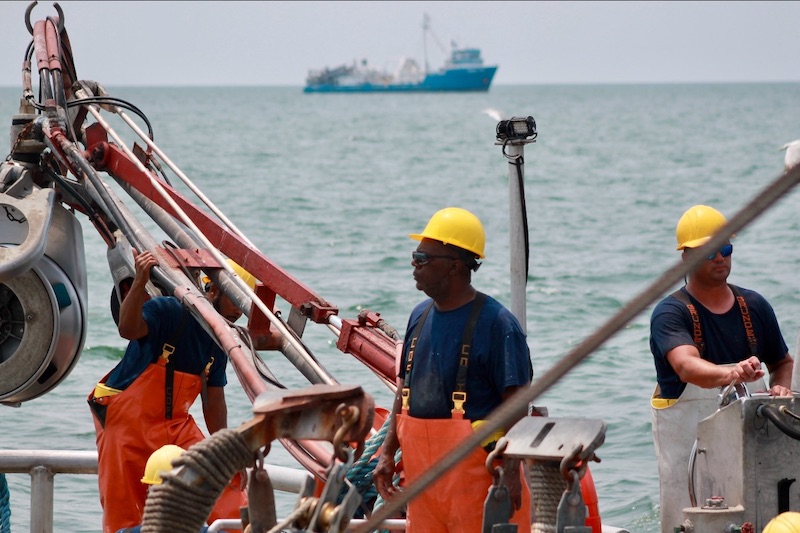
The Reedville fishery supports a heavily unionized, predominantly minority workforce, including African American fishermen and processing employees represented by United Food and Commercial Workers (UFCW) Local 400. These jobs provide wages, health benefits and retirement security in Virginia's Northern Neck, where comparable employment is limited. These multigenerational Northern Neck families have a direct stake in a healthy Bay: their future depends on healthy waters, thriving fish and birds, and a sustainable fishery. UFCW Local 400 has also put the workers themselves on camera to describe what the fishery and these jobs mean to their families and communities. One worker says: "They're not on these boats just to go out there and play." In an October 27 statement, UFCW Local 400 urged lawmakers and the ASMFC to refrain from additional Chesapeake Bay menhaden restrictions until ongoing research establishes their necessity, arguing that conservation and workers' rights belong together and that affected workers must have a voice. The NAACP Virginia State Conference has likewise urged Virginia to maintain the existing Bay Cap while state-funded research is completed, while the Southern Christian Leadership Conference has described further restrictions on these workers and families as an issue of economic justice and civil rights.
The ASMFC's own Committee on Economics and Social Sciences warns that the fishery's high fixed costs create a minimum operating threshold: sufficiently deep cuts could force a complete processing-plant shutdown, though the precise threshold is not known. Those are not abstract consequences. They are family-supporting union jobs at risk.
The contrast is unmistakable: the video features happy recreational fishermen displaying trophy red drum aboard a pleasure boat, but pays no attention to the predominantly minority union fishermen and processing workers whose livelihoods could be destroyed by the restrictions Poston demands. Recreational fishing interests are entitled to advocate for greater access. But why should their preferences prevail over family-supporting union jobs without evidence of a corresponding biological benefit? Poston cannot credibly suggest that commercial fishermen are united behind his demands while omitting the fishermen and union workers who oppose them. The question Poston never answers is why those workers should pay the price.
Sources
1. TRCP, Facebook video featuring Will Poston.
2. ASMFC, 2025 Atlantic Menhaden Stock Assessment Update, p. 5 - stock status.
3. ASMFC, Atlantic Menhaden FAQ, p. 3 - 20% TAC reduction and 0% projected probability of overfishing in 2026.
4. ASMFC, Atlantic Menhaden FAQ, p. 7 - striped bass rebuilding and osprey treatment in the ecosystem model.
5. ASMFC, 2020 ERP adoption release - ecological reference points and predator accounting.
6. Marine Stewardship Council, U.S. Atlantic menhaden purse-seine fishery - current certification record.
7. TRCP, "Anglers Praise Decision to Strengthen Striped Bass Populations" (Aug. 5, 2020).
8. ASMFC, Draft Addendum II, p. 3 - Statement of the Problem and proposed reductions.
9. ASMFC, Draft Addendum II, p. 6 - Bay Cap history and precautionary origins.
10. ASMFC Atlantic Menhaden Work Group, Precautionary Management of Chesapeake Bay, p. 1 - Work Group did not determine whether menhaden supply met predator demand.
11. ASMFC, Technical Guidance Document, Appendix 8, p. 64 - addendum "Statement of the Problem."
12. ASMFC, Amendment 2, PDF p. 63 - Bay Cap not based on a scientifically quantified threshold, health index, or population-level study.
13. ASMFC Chair James J. Gilmore Jr., response to Virginia appeal, p. 4 - signed letter on file; precautionary compromise and threshold basis.
14. ASMFC Chair James J. Gilmore Jr., response to Virginia appeal, p. 5 - signed letter on file; nursery-area evidence finding and recommendations.
15. ASMFC, Menhaden Board meeting packet, PDF p. 21 - later public corroboration of the appeal discussion.
16. John V. O'Shea, congressional testimony, p. 2 (May 8, 2008) - localized depletion data limitations and precautionary Bay Cap.
17. Science Center for Marine Fisheries, Chesapeake Bay research roadmap (Oct. 23, 2025).
18. Science Center for Marine Fisheries, SCEMFIS-supported research update (May 4, 2026).
19. Virginia Institute of Marine Science, Atlantic Menhaden research overview - Virginia and federal research funding.
20. UFCW Local 400, worker video announcement (Oct. 27, 2025).
21. UFCW Local 400, statement on proposed Chesapeake Bay menhaden cuts (Oct. 27, 2026).
22. NAACP Virginia State Conference, letter from Rev. Dr. Cozy Bailey to Gov. Abigail Spanberger, Oct. 20, 2026 (letter on file).
23. Southern Christian Leadership Conference, letter to Maryland Gov. Wes Moore (June 30, 2026).
24. ASMFC Committee on Economics and Social Sciences, updated menhaden jobs review (July 13, 2026) - fixed costs, minimum operating volume, and shutdown risk.
25. Chesapeake Bay Foundation fundraising envelope - "The Bay's food chain is at risk" / "We need your help to protect menhaden!" (mailing image on file).
26. Chesapeake Bay Foundation, "Save the Bay News: Why Menhaden Matter" - menhaden newsletter and matching-gift appeal.
About the American Small Pelagics Network
The American Small Pelagics Network represents fishermen, processors, suppliers, and coastal communities connected to fisheries such as menhaden, mackerel, herring, squid, and butterfish. ASPN supports sustainable fisheries management that supports critical fish species, while maintaining economic opportunities for fishermen and fishing communities.
Press Contact
Stove Boat Communications
202-595-1212
contact@smallpelagics.com
SOURCE: American Small Pelagics Network
View the original press release on ACCESS Newswire