Edina, Minnesota–(Newsfile Corp. – February 27, 2026) – Distracted driving remains a leading contributor to road deaths in North America according to official statistics. New research from the Traffic Injury Research Foundation USA, Inc. (TIRF USA) analyzed results of a national survey of 1,217 youth from 26 states. It investigated how risky behaviors evolve as teens age and they gain driving experience, taking a closer look at age-related patterns in teen smartphone use, risk perception, and social influences to target prevention strategies. The survey was conducted in partnership with the National Distracted Driving Coalition (NDDC) with support from State Farm®.
“When it comes to distraction, a key takeaway is that teen perceptions of cognitive risk in particular are not always aligned with real risk. More concerning, relatively limited driving experience can lead to overconfidence because teens dramatically underestimate the amount and types of experience needed to become a safe driver,” says Robyn Robertson, NDDC Chair and President & CEO of TIRF. “These two critical elements are playing out to create a situation in which teens feel confident and distracting behaviors become normalized in a relatively short period of time.”
Smartphone use increases with age
The survey revealed overall phone use while driving rises sharply with age.
-
Less than one in five teens aged 14-15 reported using a phone while driving in the past 30 days, compared with about one in three teens aged 16-17 and nearly half (48%) of teens aged 18-20.
-
Daily texting while driving also increased with age, from 18% among teens aged 14-15 to 36% among those aged 18-20.
-
Similarly, making phone calls while driving increased from 41% to 70% across the same age span.
“Interestingly, content-related behaviors such as watching videos or creating posts were more common among younger teens and declined with age,” says Milad Delavary, TIRF Research Scientist. “This suggests that high-visual-demand distractions, such as reading text, viewing images or live streaming, are more prevalent among novices, whereas older teens focus more on tasks perceived as lower risk, such as GPS navigation or phone calls, despite the cognitive load these activities impose.”
Their reasons for using their phone while driving also shifted with age.
-
The youngest teens were most concerned their parents/guardians would be upset if they didn’t answer the phone and this gradually declined with age.
-
Avoiding delays in responding to messages was a more prominent concern for teens aged 14-15, however its importance dropped among the oldest age group.
-
In contrast, boredom and loneliness as a factor increased significantly as teens aged from 14-15 to 18-20.
-
Using the phone for fun with little sense of risk also increased with age, peaking among teens aged 18-20.
The primary factors contributing to teens using their cell phone while driving evolve as they age, and this distinction is important to help parents and driver educators to tap into appropriate messaging that will discourage their usage. Of concern, these results also provide evidence that the patterns of usage become normalized in their initial years of driving. This underscores the essential need for early education about safe driving before teens get behind the wheel.
Parents and guardians shape behavior
It’s been long recognized that social influences play a critical role in shaping teen driving habits. In other words, children are learning to drive long before they’re old enough to sit in the driver seat. But it may surprise parents/guardians to know how substantial an impact they have on how their teen ultimately drives. Survey results revealed nearly half of teens said their parents or guardians had the greatest influence on how they drive. One in two teens across age groups said the adults who most often drive them used their smart phone sometimes. One in ten teens said adults almost always used their phone while driving with the highest percentage (14%) among teens aged 16-17. Conversely, less than one in five (16%-17%) teens across all age groups reported adult drivers never use their cell phone while driving. These results are a wake-up call for parents/guardians subscribing to the Do as I say, not as I do model.
“Parents and guardians are the first driving teachers, whether they realise it or not,” said Karen Bowman, founder of TIRF’s Drop It And Drive® program. “Children watch from a very young age how adults manage devices in the car in addition to seatbelt use, speed and other driving behaviors such as merging etiquette and exhibiting road rage. When adults consistently model safe-driving behaviors, children become teens who are more likely to emulate them. When it comes to safe driving, parents and guardians must lead by example long before their teen enrolls in driver’s education.”
Motivators for self-regulation
Despite high rates of device use, the survey offered encouraging evidence of some self-regulation among youth. Emotional motivators, particularly fear of causing harm or loss of life to others or themselves, were cited as the strongest deterrents to distracted driving. These were ranked as being more influential than fines, license suspension, or even peer disapproval. Use of Do Not Disturb mode while driving was the most common strategy to avoid distraction across all age groups although use of this feature declined with age. Switching the phone to silent was the second most popular among 14-15-year-olds (37%). Putting it out of reach or giving the phone to a passenger was the preferred alternative for 44% of 16-17-year-olds and 39% of 18-20-year-olds. It’s important to communicate to youth that these strategies are not just for teen drivers while they learn to drive. Instead, these are safety strategies widely embraced by many drivers, including those with decades of experience.
“Distracted driving continues to be a significant issue on our roadways for all drivers,” said Jon Wey, Director of Customer & Technology Insights at State Farm®. “However, when layered with driving inexperience and other risky behaviors such as speeding and seatbelt non-use, being distracted behind the wheel is especially dangerous for young drivers. Parental role modeling of safe driving behaviors, selecting vehicles for teens that are equipped with crash prevention technologies and have good crash test ratings, and participation in telematics-based insurance programs are all key strategies for helping keep young drivers safe.”
Perceptions of peer approval also shifted with age. The proportion of teens who felt their friends disapproved of distracted driving declined, while perceptions of peer acceptance of smartphone use while driving grew increasingly prevalent among older teens. At the same time, survey results revealed that few teen drivers had a passenger speak up to them about distracted driving. Approximately three-quarters of all participants reported not being asked to stop using their smartphone while driving. But notably, the proportion of teens saying they had been asked to stop increased with age from 9% (14-15) to 19% (18-20), a statistically significant difference. This perhaps suggest teens may gain confidence to speak up with age and driving exposure as they accrue heightened awareness of risks.
Implications for prevention
These findings highlight a clear need for age-specific strategies to prevent distracted driving as teens gain on-road experience:
-
Younger teens (14-16): Focus on early prevention of high-visual-demand behaviors such as video creation, content consumption, or live streaming.
-
Older teens (17-20): Reinforce that tasks perceived as safe, like GPS navigation or hands-free calling, still impose cognitive distractions which increase crash risk.
-
Parents and guardians: Model distraction-free driving consistently and engage in active coaching.
-
Peer-to-peer influence: Empower teens to speak up and model safe behaviors among their friends.
Looking more broadly at the results as a whole, there are two key takeaways from this research:
-
Teen driver education should not be considered or framed as a one-shot deal. Learning to drive does not end with driver education because the scope and breadth of driving experience gained is miniscule relative to the knowledge accrued by an individual who has driven for two decades. The prevalence of deaths among teen drivers remains a clear indicator that more work is needed to establish a continuum of learning to drive strategies to ensure safety behaviors are truly ingrained. Nowhere is this more evident than in the substantial death rates among young drivers age 20 to 24.
-
The findings suggest it’s critical we communicate to teens how much driving experience is necessary to become a competent and confident driver. The survey results showed that at least a proportion of teens expressed a high level of confidence despite having only two or three years of driving experience in a fairly limited geographical area. It’s important for parents/guardians and instructors to check in with their teen drivers and actively moderate their level of confidence by giving them a more objective assessment of the relatively limited experience they have gained.
Download Youth Distracted Driving Survey | Teen Smartphone Use While Driving: Age Comparisons of Risky Behaviors, Perceptions & Attitudes: https://bit.ly/Youth-Distracted-Driving-Survey
Download Teen Smartphone Use While Driving: Age Comparisons of Risky Behaviors, Perceptions & Attitudes | Summary: https://bit.ly/NDDC-Youth-Summary
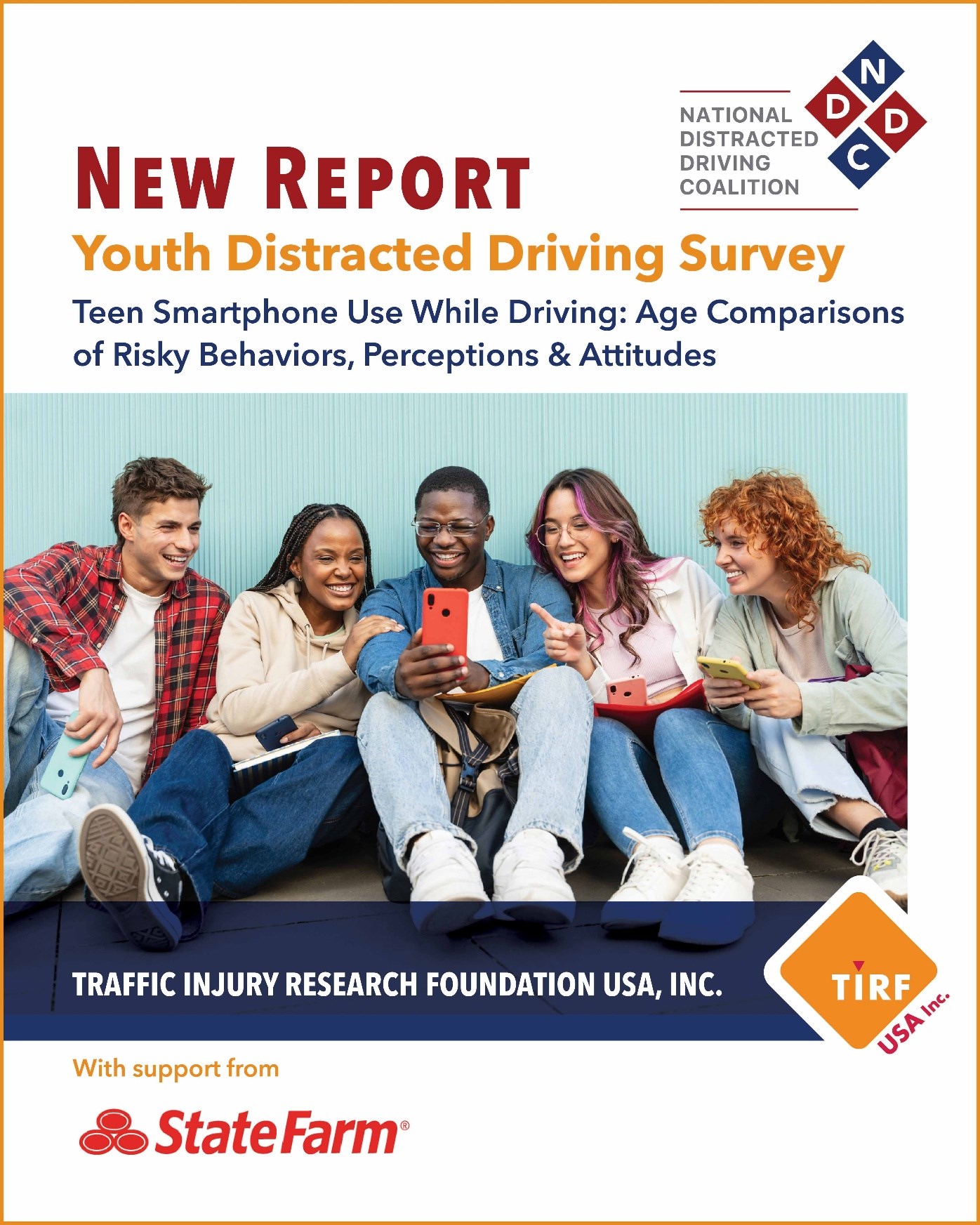
Teen Smartphone Use While Driving: Age Comparisons of Risky Behaviors, Perceptions & Attitudes
To view an enhanced version of this graphic, please visit:
https://images.newsfilecorp.com/files/11607/285318_77fe106ae449db59_001full.jpg
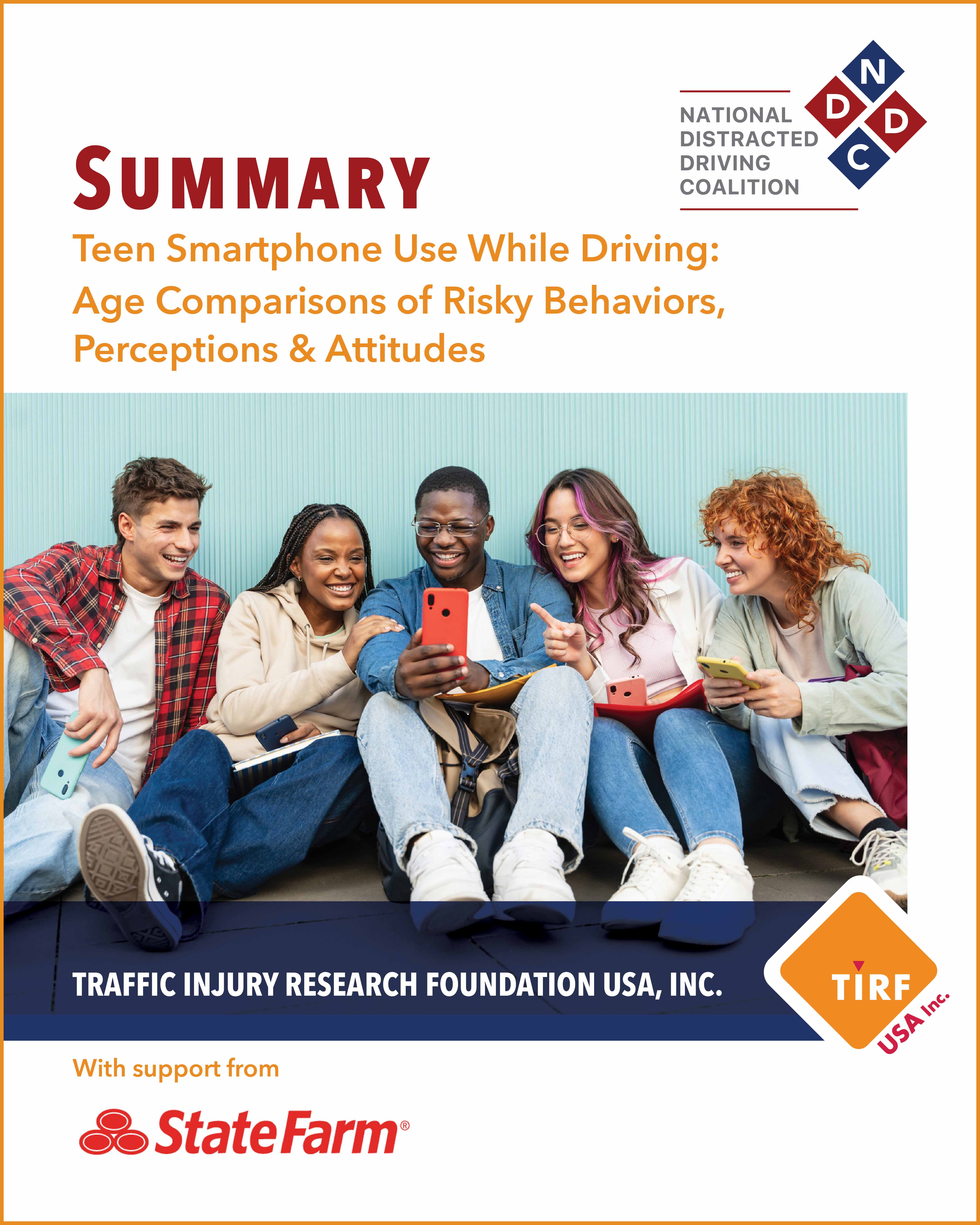
Teen Smartphone Use While Driving: Age Comparisons of Risky Behaviors, Perceptions & Attitudes | Summary
To view an enhanced version of this graphic, please visit:
https://images.newsfilecorp.com/files/11607/285318_nddcyouthsurvey_age_riskybehaviours_sum_ad_1sm.jpg
About the survey:
On behalf of the US National Distracted Driving Coalition (NDDC), the Traffic Injury Research Foundation, USA, Inc. (TIRF USA) conducted a survey of youth on the topic of distracted driving. A total of 1,217 young drivers responded to the survey from 26 states, with 95 respondents opting not to disclose their state. Individual links were provided to US-based youth organizations to distribute the anonymous survey to teens aged 15 to 20. Responding states included: AL, AZ, CA, CO, DE, FL, GA, IL, IN, KS, MD, MA, MI, MO, NE, NJ, NY, OH, OK, PA, TN, SC, TX, VA, DC, WY.
About TIRF USA
The mission of the Traffic Injury Research Foundation USA, Inc. (TIRF USA) is to develop and share the knowledge that saves – preventing injuries and loss of life on American roads, reducing related social, health and insurance costs, and safeguarding productivity. TIRF USA is an independent road safety research institute with 501(c)3 non-profit status in the U.S., established in 2014, and is affiliated through an exchange of services agreement with TIRF in Canada, established in 1964. Visit us online at www.tirf.us or twitter.com/tirfusainc
About the National Distracted Driving Coalition
The National Distracted Driving Coalition was formed in March 2021 to address distracted driving which is a contributing factor to road deaths and injuries. This road safety issue is a priority concern shared by many organizations across many sectors. A diverse cross-section of entities, representing academia, non-profits, government, advocacy, and industry, including insurance, transportation, automotive and technology, have come together to create a National Action Plan to tackle this important issue. Learn more at https://usnddc.org.
For more information, please contact:
TIRF USA Inc. Corporate Office
Corporate Office – 6928 Langford Drive, Edina, MN 55436
Tel.: 814-404-1681
Website: www.tirf.us
Email: tirf@tirf.us | karenb@tirf.ca
Media contact: Karen Bowman, Traffic Injury Research Foundation
Direct: 250-797-0833
NDDC media contacts:
|
Joe Young
|
Nick Chabarria Automobile Club Of Missouri Office: 314-523-7350 x1066305 Cell: 708-269-1667 chabarria.nick@aaamissouri.com |

To view an enhanced version of this graphic, please visit:
https://images.newsfilecorp.com/files/11607/285318_tirfusaxnddc.jpg
To view the source version of this press release, please visit https://www.newsfilecorp.com/release/285318
COMTEX_474331037/2523/2026-02-27T08:01:56