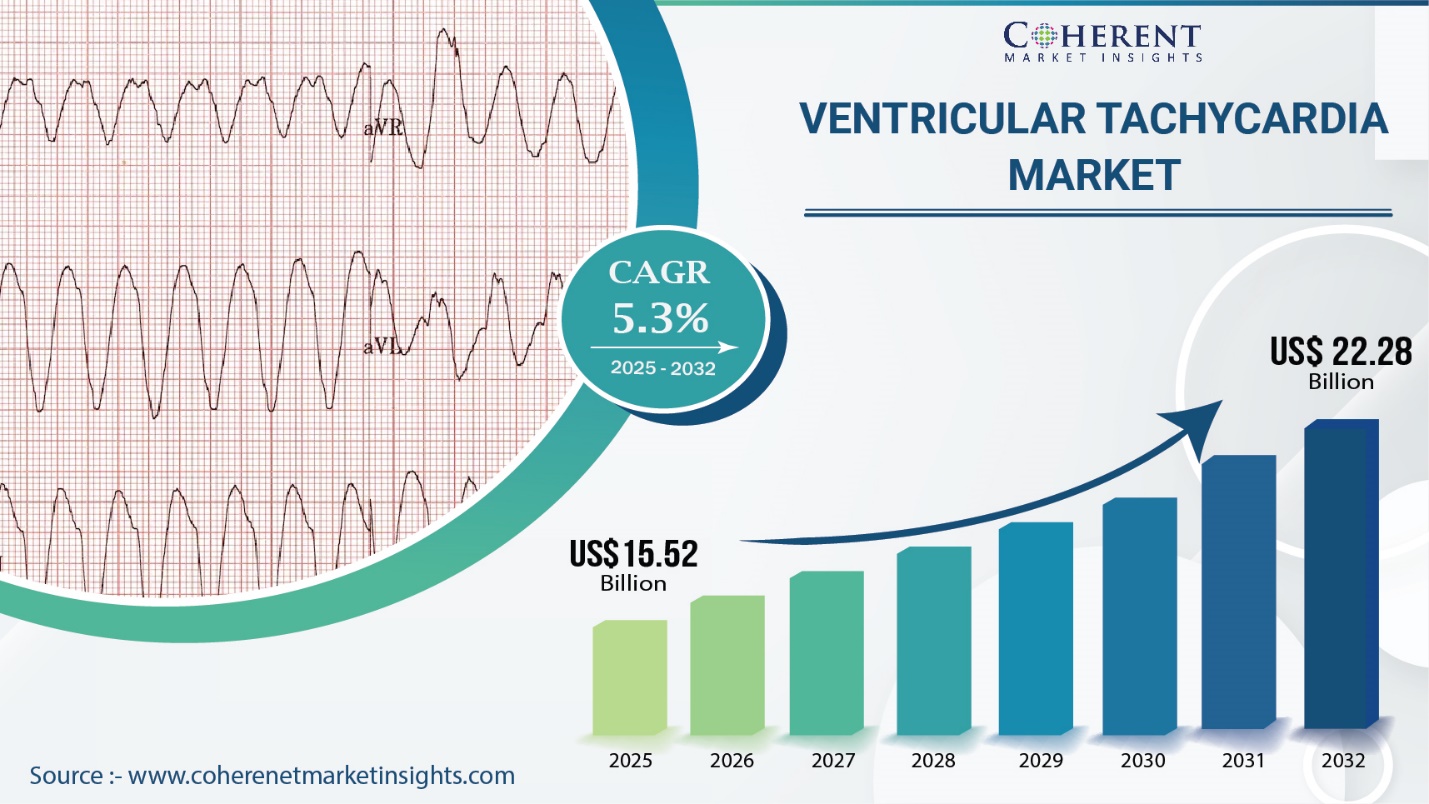
Burlingame, CA, Jan. 15, 2026 (GLOBE NEWSWIRE) — The Global Ventricular Tachycardia Market is estimated to be valued at USD 15.52 Bn in 2025 and is expected to reach USD 22.28 Bn by 2032, reflecting a compound annual growth rate (CAGR) of 5.3% from 2025 to 2032. This consistent growth is driven by the rising incidence of cardiovascular diseases, ongoing advancements in diagnostic and therapeutic technologies, and increasing global awareness of ventricular tachycardia management. Additionally, the expansion of healthcare infrastructure and a growing patient population are expected to further support market growth throughout the forecast period. Request a Sample Copy of the Report @ https://www.coherentmarketinsights.com/insight/request-sample/9119 Global Ventricular Tachycardia Market Key Takeaways Antiarrhythmic drugs remain the most commonly used drug type for ventricular tachycardia treatment, with this segment accounting for a market share of 65.2% in 2025. Based on drug class, Class I (sodium channel blockers) segment is set to dominate the global ventricular tachycardia industry with a share of 34.5% in 2025. By disease type, the non-ischemic ventricular tachycardia segment accounted for 55.7% of the market share in 2025. North America is projected to account for nearly two-fifths of the global ventricular tachycardia market share in 2025. Asia Pacific, with a share of 23.5% in 2025, is anticipated to emerge as a highly lucrative market for ventricular tachycardia drug manufacturers during the forecast period. Increasing Burden of Cardiovascular Diseases Spurring Market Growth Coherent Market Insights' latest ventricular tachycardia market analysis outlines prominent factors driving market growth. Rising prevalence of cardiovascular diseases, increasing geriatric population, growing demand for antiarrhythmic drug therapies, and advancements in drug formulations are some major ventricular tachycardia market growth factors. The global increase in cardiovascular conditions like hypertension, coronary artery disease, heart failure, cardiomyopathies, obesity, and diabetes significantly raises the risk of ventricular tachycardia and other ventricular arrhythmias. This, in turn, is driving demand for ventricular tachycardia medications. Buy the Complete Report with an Impressive Discount (Up to 40% Off ) at: https://www.coherentmarketinsights.com/offernew/buy-now/9119 Safety Concerns and Non-Pharmacological Therapies Limiting Market Growth The global ventricular tachycardia market outlook remains positive, owing to rising prevalence of ischemic heart disease and heart failure and an increase in FDA-approved ventricular tachycardia drugs. However, growing safety concerns and rising adoption of non-pharmacological treatments might slow down ventricular tachycardia market growth to some extent during the forecast period. Many antiarrhythmic drugs cause adverse effects like proarrhythmia, organ toxicity, and QT prolongation. This can limit prescribing and patient adherence, thereby dampening overall ventricular tachycardia market demand. In addition, there is an increasing adoption of device based therapies like implantable cardioverter defibrillators, pacemakers, and catheter ablation. These alternative therapies reduce reliance on drugs because they often offer better long term outcomes. Advancements in Diagnostic Technologies Creating Growth Opportunities Improvements in diagnostic tools, such as advanced ECGs, electrophysiological mapping systems, continuous ambulatory monitoring, and AI assisted detection, enable earlier and more accurate ventricular tachycardia diagnosis. Early detection increases treatment uptake and improves prognosis. Thus, continuous technological advancements, along with increasing diagnostic rates, are expected to open revenue streams for manufacturers of ventricular tachycardia drugs during the forecast period. Emerging Ventricular Tachycardia Market Trends Rising antiarrhythmic drug therapy demand is a key trend in the ventricular tachycardia market. There is a steady increase in sales of antiarrhythmic drugs like amiodarone, lidocaine, procainamide and sotalol because they are widely used for the treatment of ventricular tachycardia. These ventricular tachycardia medications have the potential to directly stabilize cardiac electrical activity. They are projected to hold a large share of pharmacological ventricular tachycardia management. There is a rising trend towards personalized therapies, especially in developed nations like the U.S. Companies are shifting their focus towards developing tailored ventricular tachycardia therapies based on individual risk factors. Another emerging trend is the adoption of combination therapies. There is a rising trend towards combined pharmacological and device-based approaches. For example, antiarrhythmic drugs are being used alongside catheter ablation or implantable cardioverter-defibrillators. These combination therapies are optimizing patient outcomes. Growing geriatric population is fueling demand for ventricular tachycardia drugs. Older populations are more prone to cardiac rhythm disorders, including VT, due to age-related changes in heart structure and electrical conduction. This demographic trend is slated to boost growth of ventricular tachycardia market during the forecast period. Rising awareness among patients and healthcare providers about VT risks and the importance of timely intervention encourages more people to seek treatment. Expansion of healthcare infrastructure in developing regions also drives ventricular tachycardia industry growth. Leading companies are developing innovative antiarrhythmic agents and advanced formulations that aim to improve efficacy and safety. These include extended-release formulations and patient-friendly oral ventricular tachycardia drugs. Request For Customization: https://www.coherentmarketinsights.com/insight/request-customization/9119 Analyst's View “The global ventricular tachycardia market is expected to grow steadily, driven by the increasing incidence of cardiac arrhythmias, advancements in diagnostic technologies, growing demand for antiarrhythmic drug therapies, and advancements in ventricular tachycardia drug formulations,” said the senior analyst at CMI. Current Events and Their Impact on the Ventricular Tachycardia Market Competitor Insights Key companies listed in the ventricular tachycardia market report include: Key Developments In December 2025, the U.S. FDA approved Cardamyst (etripamil) nasal spray to treat episodes of paroxysmal supraventricular tachycardia (PSVT). In November 2024, the U.S. FDA approved AOP Health's Rapiblyk (landiolol) for the treatment of severe heart condition supraventricular tachycardia, including atrial fibrillation and atrial flutter, in critical care settings. Market Segmentation Drug Type Insights (Revenue, USD Bn, 2020 – 2032) Drug Class Insights (Revenue, USD Bn, 2020 – 2032) Disease Type Insights (Revenue, USD Bn, 2020 – 2032) Route of Administration Insights (Revenue, USD Bn, 2020 – 2032) Therapy Line Insights (Revenue, USD Bn, 2020 – 2032) Patient Age Group Insights (Revenue, USD Bn, 2020 – 2032) Type Insights (Revenue, USD Bn, 2020 – 2032) Distribution Channel Insights (Revenue, USD Bn, 2020 – 2032) End User Insights (Revenue, USD Bn, 2020 – 2032) Regional Insights (Revenue, USD Bn, 2020 – 2032) Related Reports: Our Trusted Partners:
Event
Description and Impact
Regulatory and Policy Developments
Technological Disruption and Innovation
Demographic and Epidemiological Shifts
Acute Ischemic Stroke Market Outlook for 2025-2032
Ventricular Tachycardia Ablation Market Size, Share, Trends & Opportunities for 2026-2033
Ventricular Assist Devices Market Analysis & Forecast for 2025-2032
Worldwide Market Reports, Coherent MI, Stratagem Market Insights
Get Recent News:
https://www.coherentmarketinsights.com/news

About Us:

Coherent Market Insights leads into data and analytics, audience measurement, consumer behaviors, and market trend analysis. From shorter dispatch to in-depth insights, CMI has exceled in offering research, analytics, and consumer-focused shifts for nearly a decade. With cutting-edge syndicated tools and custom-made research services, we empower businesses to move in the direction of growth. We are multifunctional in our work scope and have 450+ seasoned consultants, analysts, and researchers across 26+ industries spread out in 32+ countries.

Contact Us:

Mr. Shah
Coherent Market Insights Pvt. Ltd,
U.S.: + 12524771362
U.K.: +442039578553
AUS: +61-2-4786-0457
INDIA: +91-848-285-0837
Email: sales@coherentmarketinsights.com
For Latest Update Follow Us:
LinkedIn | Facebook | Twitter