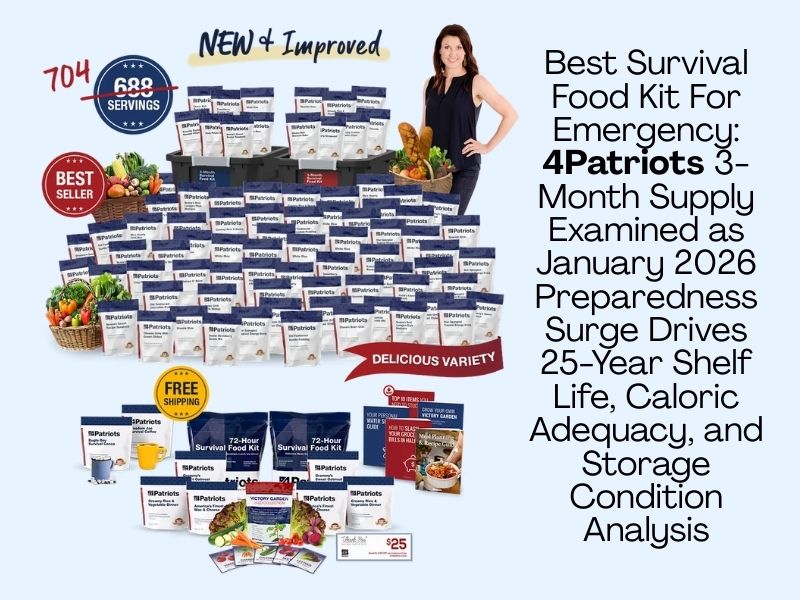
Nashville, TN, Jan. 02, 2026 (GLOBE NEWSWIRE) — Disclaimer: This article is for informational purposes only and does not provide recommendations or endorsements. Preparedness needs vary by household. Affiliate links may generate a commission at no additional cost. Product details are based on manufacturer-published materials and should be verified directly with the brand. As January 2026 begins, consumer interest in emergency food storage typically rises during winter-weather planning and year-ahead household preparedness reviews. This consumer analysis examines one widely searched option–the 4Patriots 3-Month Survival Food Kit–using common evaluation criteria such as shelf-life disclosures, calorie transparency, storage considerations, and preparation requirements. It is not a recommendation, ranking, or endorsement. When consumers search for “best survival food kit for emergency,” they typically seek answers to interconnected questions: How can I verify manufacturer claims? Will my family actually consume this food during a crisis? How do claimed shelf lives hold up under realistic home storage conditions? What constitutes adequate daily caloric content? How do I store 90 days of food in limited space? This analysis addresses these questions by examining the 4Patriots 3-Month Kit as a detailed case study within broader emergency food supply market context. Readers who want to verify the current label disclosures and specifications referenced in this analysis can view the current 4Patriots 3-Month Survival Food Kit offer (official 4Patriots page). Methodology Note: What This Analysis Is (and Is Not) This article summarizes publicly available manufacturer specifications and general emergency-preparedness guidance. It uses a case-study approach to explain how consumers often evaluate long-term food storage products–for example: shelf-life disclosures, calorie totals per day, storage footprint, and preparation needs. It does not rank brands, declare a product “best,” or provide individualized preparedness advice. All product specifications are attributed to manufacturer materials and should be verified directly with the company. What Is an Emergency Food Kit? Understanding Basic Definitions An emergency food kit is a pre-packaged collection of preserved foods designed to provide calories and basic nutrition during situations when normal food access is disrupted–such as natural disasters, power outages, or supply chain interruptions. These kits typically use freeze-drying or dehydration preservation methods to achieve extended shelf life without refrigeration. The distinction between servings and calories per day represents a critical evaluation factor: a “serving” is a manufacturer-defined portion size that may not align with typical meal portions or individual caloric needs, while “calories per day” provides the actual daily energy content when the total calorie count is divided by the claimed duration. This calculation helps consumers assess whether a kit provides adequate nutrition or requires supplementation. January 2026 Preparedness Context: Seasonal Interest and Year-Ahead Planning Seasonal interest in emergency preparedness topics often rises in early Q1 as households revisit year-ahead planning and winter-weather readiness. Some households also choose to review long-term food storage options during this period, especially when winter storms or regional disruptions raise awareness. This seasonal pattern reflects several converging factors: New Year resolution implementation around household safety and self-sufficiency goals, post-holiday budget availability when discretionary spending capacity returns, winter storm season awareness across northern and central regions prompting weather-specific preparedness, and increased visibility of emergency preparedness messaging across media channels during the winter season. The 4Patriots 3-Month Survival Food Kit has emerged as a frequently searched option within the emergency food storage category during the January 2026 preparedness season, prompting this examination of how its published specifications align with consumer evaluation criteria that have evolved significantly since emergency preparedness awareness surged during 2020 pandemic-related supply disruptions. What “Best Survival Food Kit For Emergency” Usually Means: Decoding Search Intent When consumers search for “best survival food kit for emergency,” they rarely seek a definitive product ranking. Instead, search behavior analysis reveals they're typically asking: “What benchmarks should I use to evaluate emergency food options for my specific household circumstances?” Common evaluation categories include: shelf-life verification (not just the number, but storage condition requirements), caloric adequacy (actual daily calories versus inflated serving counts), recipe variety (preventing taste fatigue during extended emergencies), storage footprint (space requirements and temperature sensitivity), preparation simplicity (equipment and water needs), manufacturing transparency (certifications and facility documentation), and company verification (business documentation and customer service accessibility). This analysis examines how the 4Patriots 3-Month Kit addresses each of these categories according to manufacturer-published specifications, providing a framework consumers can apply when evaluating any emergency food storage option. The 2026 Emergency Food Supply Market: Understanding Industry Context Before examining specific product specifications, understanding broader emergency food supply market dynamics helps consumers evaluate where different approaches fit within their preparedness strategy and budget parameters. The emergency food storage industry has evolved significantly since 2020, transforming from a niche preparedness category into a mainstream consumer market serving multiple household priorities beyond traditional disaster preparedness–including supply chain resilience concerns, inflation hedging through bulk purchasing, and outdoor recreation meal solutions. The North American emergency food market generally segments into distinct tiers: Premium Freeze-Dried Tier emphasizes backpacking-quality taste through specialized freeze-drying technology, lightweight portability for outdoor recreation applications, individual meal pouches, and extended shelf life claims supported by military and aerospace-grade preservation methods. This segment targets consumers willing to pay premium prices for taste quality and multi-purpose functionality. Mid-Market Family-Focused Tier emphasizes comprehensive meal variety across 20-30 recipes, family-sized portions designed for multi-person households, made-in-USA manufacturing claims, patriotic brand positioning, and ease of preparation requiring only boiling water. This segment has experienced substantial growth in consumer acquisition since 2020. Budget-Oriented Bulk Tier emphasizes lower per-calorie costs through large-format packaging, #10 cans providing maximum storage efficiency, bulk ingredients requiring consumer meal assembly, and greatest customization flexibility for experienced preparedness households. Consumer evaluation criteria in 2026 emphasizes:caloric transparency moving beyond inflated serving counts, recipe variety exceeding basic rice-and-beans staples, manufacturing origin verification and quality certifications, realistic shelf-life disclosures including explicit storage condition requirements, and cost-per-day calculations accounting for supplementation requirements. The 4Patriots 3-Month Survival Food Kit positions within the mid-market family-focused segment according to manufacturer materials, which the following sections examine in detail. How Many Calories Per Day Does a 90-Day Emergency Food Kit Typically Provide? According to USDA dietary guidelines available through resources like MyPlate.gov and healthcare organizations such as Kaiser Permanente, calorie needs vary by age, sex, weight, activity level, and health conditions, typically ranging from 1,600 to 2,400 calories per day for adults. Emergency food kits often provide what manufacturers describe as “baseline emergency nutrition” (typically 1,400-1,600 calories daily) rather than complete caloric replacement. This baseline assumes reduced activity levels during emergencies and often requires supplementation to meet full daily nutritional requirements. Consumers evaluating emergency food options should perform this calculation: total calories divided by claimed duration equals daily calories provided, then compare that number against household needs. For example, a kit containing 140,000 total calories marketed as a “90-day supply” provides approximately 1,556 calories per day (140,000 ÷ 90 = 1,556). This calculation reveals whether the kit provides adequate nutrition or requires supplementation–particularly important for larger individuals, active people, growing children, pregnant women, or households with elevated caloric needs. What Does “25-Year Shelf Life” Usually Depend On? Shelf life claims for emergency food products depend critically on storage conditions, preservation methods, and packaging technology. Products claiming 20-25 year shelf lives typically employ freeze-drying or low-heat dehydration combined with moisture-barrier packaging materials like Mylar and oxygen absorbers. Critical factors affecting actual shelf life include: Storage Temperature: Consistent temperatures below manufacturer-specified limits (often 75°F) year-round. Higher temperatures accelerate degradation of food quality, nutritional content, and taste. Each 10-degree increase above optimal temperature can reduce shelf life by several years. Humidity Control: Moisture represents one of the primary threats to long-term food storage. Even with moisture-barrier packaging, storage areas with high humidity increase risk of packaging degradation over decades. Light Protection: Direct sunlight and UV exposure degrade both packaging materials and food quality over time. Storage in dark locations like closets protects against light damage. Packaging Integrity: Any damage to moisture barriers, oxygen-absorber failure, or seal compromise can dramatically reduce shelf life regardless of preservation technology quality. Consumers should recognize that “25-year shelf life” typically represents potential longevity under optimal conditions consistently maintained–not guaranteed performance under all possible storage circumstances. Real-world home storage in garages, attics, or non-climate-controlled spaces experiencing temperature fluctuations or humidity exposure may significantly reduce theoretical maximum shelf life. Shelf-Life Claims: What Consumers Should Look for When Evaluating Emergency Food One of the most prominent features in emergency food marketing involves shelf-life claims, typically ranging from 5 years to 30 years depending on preservation methods and packaging technology. Understanding what these numbers actually mean requires examining the underlying preservation science and storage condition requirements. Critical factors that consumers should verify when evaluating any shelf-life claim include: Storage Condition Specifications: Does the manufacturer explicitly state required storage conditions (temperature range, humidity levels, light protection)? Qualifier Language: Does the claim include “under proper storage conditions” or similar conditional language acknowledging that real-world conditions may vary? Packaging Technology: What specific moisture-barrier and oxygen-removal methods are used? Temperature Sensitivity: What happens to shelf life if products are stored in garages, attics, or other non-climate-controlled spaces? These verification steps help consumers distinguish between theoretical maximum shelf life under optimal laboratory conditions versus realistic longevity expectations for home storage situations. Calorie Transparency: Servings vs. Real Daily Calories One of the most frequently misunderstood aspects of emergency food kits involves the difference between serving counts and actual daily caloric adequacy. Duration marketing claims like “30-day supply” or “90-day supply” require careful examination of daily caloric content and comparison against household nutritional needs. Common pitfalls consumers encounter when evaluating serving counts include: Inflated Serving Definitions: Some manufacturers define “servings” as small portions (e.g., 1/2 cup) that most people would consume multiple servings of in a single meal. Incomplete Daily Coverage: A kit claiming “30 days” may provide only breakfast and lunch, requiring separate dinner solutions. Caloric Inadequacy: Daily caloric totals may fall significantly below the 2,000-2,500 calories most adults require, necessitating supplementation. Activity Level Variations: Baseline emergency nutrition (1,400-1,600 calories/day) may be insufficient for active individuals, larger people, or growing children. Transparent manufacturers explicitly disclose daily caloric totals and acknowledge when supplementation may be necessary to meet complete nutritional requirements. This disclosure practice represents responsible marketing that helps consumers make informed decisions. How Much Storage Space Does a 90-Day Emergency Food Kit Usually Require? Emergency food supplies must be stored somewhere, and that storage location must meet specific environmental conditions to preserve food quality and achieve advertised shelf life. Consumers evaluating emergency food options should assess both the storage footprint (physical space required) and storage condition requirements (environmental specifications). Typical 90-day emergency food kits for one person range from approximately 2-5 cubic feet depending on packaging efficiency, preservation method, and whether products use bulk containers versus individual meal pouches. Multi-person household supplies scale proportionally–a family of four might require 8-20 cubic feet of storage space. Key storage factors to evaluate include: Physical Dimensions: How much space do the containers occupy? Can they stack? Will they fit under beds, in closets, or in basement storage? Weight Distribution: Are containers light enough to move easily during reorganization or evacuation? Temperature Requirements: What temperature range must be maintained? Can the storage location maintain those conditions year-round? Humidity Sensitivity: Does the packaging provide adequate moisture barriers even in humid climates or damp basements? Light Protection: Are containers opaque, or do they require storage in dark locations? Portability: If evacuation becomes necessary, can containers be quickly loaded into vehicles, or are individual pouches removable for bug-out bags? These practical storage considerations often matter as much as the food specifications themselves, since food that cannot be properly stored will not achieve its advertised shelf life regardless of preservation technology quality. Storage Realities: Temperature, Moisture, and Space Considerations Storage condition maintenance represents the difference between achieving advertised shelf life and experiencing premature food degradation. Interior, temperature-stable locations are commonly cited by manufacturers as more suitable for long-term storage than spaces subject to extreme heat or humidity. Optimal storage locations feature: Consistent temperatures below 75°F year-round (avoiding garages, attics, or outdoor buildings with temperature extremes) Low humidity levels preventing moisture intrusion even through sealed packaging Protection from direct sunlight and UV exposure that degrades both packaging materials and food quality Security from physical damage and pest access Convenient accessibility for periodic inspection Bedroom closets, interior basement areas with climate control, or temperature-stable storage rooms typically meet these requirements better than garages, sheds, or spaces subject to environmental fluctuation. Preparation Requirements: What's Typically Required for Emergency Food Emergency food preparation requirements vary significantly across products and preservation methods. Consumers should understand what equipment, water, and time will be required to actually prepare meals during emergency situations when stress is high and resources may be limited. Common preparation approaches in the emergency food industry include: Boil-and-Serve Methods: Require only boiling water, typically 1-3 cups per serving, with 10-15 minute preparation times. Cold-Soak Options: Some freeze-dried items can be prepared with cold water given extended soaking time (30-60 minutes). Oven or Stovetop Cooking: More complex preparation requiring functioning cooking equipment and potentially longer preparation times. Ready-to-Eat: No preparation required but typically limited to specialized items like food bars or MRE-style products. Because some emergency food products require hot water, consumers often consider whether they would have access to a reliable way to heat water during an outage (such as propane camping stoves or solar cookers), along with sufficient water for both drinking and meal preparation. According to FEMA guidance available at fema.gov, emergency water planning should account for at least one gallon per person per day, with additional amounts needed for food preparation when using dehydrated or freeze-dried products. The CDC provides similar emergency water guidance at cdc.gov. Using 4Patriots 3-Month Kit as a Case Study: What the Manufacturer Product Page Lists The following examination uses the 4Patriots 3-Month Survival Food Kit as a specific example to illustrate how consumers can evaluate emergency food specifications against the benchmarks outlined above. All information in this section is attributed to manufacturer-published materials on the official 4Patriots product page. Product Contents and Serving Specifications According to the official 4Patriots product page, the 3-Month Survival Food Kit contains 704 servings distributed across 92 individual Mylar pouches, organized into 25 distinct recipes. The manufacturer lists the total caloric content at 140,000 calories, which calculates to approximately 1,555 calories per day over 90 days when divided evenly. The product page lists recipe categories including breakfast items (Buttermilk Pancakes, Cheesy Grits with Green Chilis, Grammy's Sweet Oatmeal, Potatoes O'Brien, Sweet Strawberry Scone Mix), lunch and dinner entrees (America's Finest Mac and Cheese, Black Bean Burger Mix, Classic Bean Chili, Cowboy Rice and Beans, Creamy Rice and Vegetable Dinner, Dinner Bell Broccoli Bake, Frank's Famous Alfredo, Hearty Stroganoff, Ma's Homestyle Chili Mac, Nonna's Best Lasagna-Style Marinara, Nonna's Secret Recipe Spaghetti, Spanish Rice), soups and sides (Cozy Potato Soup, Fireside Stew, Long-Grain White Rice), and beverages and desserts (Old-Fashioned Chocolate Pudding, Old-Fashioned Vanilla Pudding, Our Heartland's Finest Powdered Milk, Sweetly Coated Banana Chips, Star Spangled Tropical Energy Drink). The manufacturer states in their product documentation: “These kits are designed to provide energy and nutrients for one person in stressful emergency situations. They are not intended to be complete caloric replacements during normal times.” The manufacturer recommends supplementing with additional food items to meet complete nutritional needs during extended emergencies. Consumer evaluation application: Consumers comparing options can use the 1,555 daily calories figure to avoid relying on serving counts alone, calculating whether that baseline matches their household's actual daily needs or whether supplementation would be necessary. Shelf-Life Claims and Storage Condition Requirements According to 4Patriots published materials, the 3-Month Kit claims a 25-year shelf life under proper storage conditions. The manufacturer specifically defines “proper storage” as protection from heat, air, and moisture, with consistent temperatures below 75 degrees Fahrenheit. The company explicitly notes on the product page: “Storage conditions impact shelf life. For best results, protect food from heat, air, and moisture. Avoid prolonged exposure to temperatures above 75°F. Shelf life will vary based on storage conditions.” The manufacturer describes the preservation methods as a combination of freeze-drying and low-heat dehydration, with meals sealed in triple-layer Mylar pouches designed to create barriers against air, light, and moisture. The product page states that high-capacity oxygen absorbers remove excess air from each pouch. Consumer evaluation application: Consumers can assess whether their intended storage location (garage, basement, closet, attic) can maintain temperatures below 75°F year-round, or whether climate control investments would be necessary to achieve the claimed shelf life. Storage Design and Physical Footprint According to product specifications on the 4Patriots website, the 3-Month Kit ships in two 14-gallon water-resistant storage totes with carrying handles. The manufacturer lists each tote's dimensions as approximately 24 inches long by 16 inches wide by 10 inches high. The product page notes the stackable design allows for under-bed storage, closet stacking, or basement organization. The manufacturer states that individual Mylar pouches within each tote can be removed for bug-out bags or distributed among family members during evacuation scenarios. Consumer evaluation application: Consumers can measure their intended storage space to verify the totes will fit (total footprint approximately 3.8 cubic feet when stacked), and can assess whether the dual-tote design aligns with their evacuation plans or distributed storage strategies. Preparation Methods and Equipment Requirements According to the manufacturer, all recipes in the 4Patriots 3-Month Kit follow a standardized “boil, simmer, and serve” preparation method requiring only boiling water. The product page lists preparation time at approximately 15 minutes per meal from start to finish. Water requirements vary by recipe but typically range from 1-3 cups per serving according to preparation instructions on the manufacturer's website. Consumer evaluation application: Consumers can consider whether they would have access to heat sources capable of boiling water during power outages, and can calculate total water needs for the 90-day period (food preparation plus drinking water) to ensure adequate water storage or filtration capabilities. Manufacturing Disclosures and Quality Certifications According to company materials available on the 4Patriots ingredients page, the company states their survival food is manufactured at a family-owned facility in Utah using ingredients sourced from the United States and internationally. The manufacturer states their facility maintains SQF certification and is registered with both the USDA and FDA. The manufacturer describes each kit as hand-packed by U.S.-based workers rather than automated machinery according to their website materials. Consumer evaluation application: For readers who want to check certification listings, SQFI maintains a searchable database used for SQF audit registration and related records; availability of specific site details may vary by listing and access settings. Policy Information The 4Patriots product page states policy information including a 365-day return policy according to their published terms. Policy specifics, eligibility, and any conditions should be verified directly with the manufacturer as terms may vary. Who This Type of Kit May (or May Not) Fit: Neutral Household Segmentation The 4Patriots 3-Month Kit–and mid-market family-focused emergency food kits generally–may align well with certain household situations while being less suitable for others. This segmentation helps consumers self-assess fit before purchasing. Households This Approach May Serve Well Disaster-Prone Geographic Locations: Families in hurricane zones, earthquake areas, wildfire interface regions, or severe winter storm territories face elevated risk requiring emergency food reserves beyond 72-hour minimums. “Set and Forget” Storage Preferences: Households seeking long-term storage solutions without active rotation management may value 25-year shelf life products requiring minimal maintenance when properly stored. Comprehensive Pre-Packaged Solutions: Families wanting immediate preparedness without extensive planning may benefit from complete kits providing multiple meal categories in single purchase. Adequate Climate-Controlled Storage: Households with closet space, under-bed storage capability, or basement areas that maintain temperatures below 75°F year-round can accommodate the storage requirements. Baseline Emergency Nutrition Acceptance: Families comfortable supplementing the 1,555 daily baseline calories with pantry items or additional food sources to reach complete daily requirements. Households Where Alternative Approaches May Be More Suitable Severe Budget Constraints: Families unable to allocate resources to emergency food kits may achieve better value through gradual DIY grocery stockpiling, accepting shorter shelf lives and rotation requirements as trade-offs. Specific Dietary Restrictions: Households managing celiac disease, severe food allergies, religious dietary laws, or medical nutrition requirements may need specialized products or custom stockpiling for complete ingredient control. Inadequate Storage Conditions: Households in hot climates without climate control, high-humidity areas, or living situations lacking temperature-stable storage may struggle to maintain conditions supporting maximum shelf life. Maximum Cost Efficiency Priority: Consumers focused primarily on lowest per-calorie costs may achieve better economics through bulk ingredient storage or strategic warehouse club purchasing. Gradual Preparedness Building: Households preferring to distribute preparedness investment across extended timeframes may benefit from starting with smaller 72-hour kits, gradually expanding as budget permits. This segmentation framework is not prescriptive–individual circumstances vary significantly–but provides a starting point for household self-assessment. Regional Risk Assessment: Location-Specific Preparedness Factors Geographic location significantly influences both the likelihood of requiring emergency food supplies and the specific characteristics those supplies should possess. Different regions face distinct disaster profiles that shape optimal preparedness strategies. Hurricane-Prone Coastal Regions According to NOAA historical data, households in Florida, Louisiana, Texas Gulf Coast, and Atlantic coastal states experience elevated frequency of multi-day power outages, mandatory evacuations, and supply chain disruptions during hurricane season (June through November). Emergency food for hurricane zones should consider portability for evacuation scenarios and extended duration since infrastructure restoration often requires weeks. Tornado Alley States According to National Weather Service data, Oklahoma, Kansas, Texas, Nebraska, Missouri, Arkansas, and Iowa experience concentrated tornado activity primarily during spring and early summer. Tornadoes can disrupt local infrastructure while leaving surrounding areas functional, creating localized supply challenges. Secure storage in basements or interior rooms that also serve as shelter spaces may be appropriate. Earthquake Zones According to USGS guidance, California, Pacific Northwest, Alaska, and the New Madrid Seismic Zone face earthquake risks that can disrupt regional supply chains for extended periods. Storage strategies should account for securing supplies against tipping or falling during seismic events. Wildfire-Affected Western States According to National Interagency Fire Center data, California, Colorado, Oregon, Washington, Arizona, Idaho, and Montana experience increasingly severe wildfire seasons. Rapid evacuation scenarios requiring portable food supplies and infrastructure damage affecting supply routes characterize wildfire risks. Portable food storage that can be quickly loaded during evacuation orders may be prioritized. Winter Storm and Blizzard Regions According to National Weather Service data, Minnesota, Wisconsin, Michigan, North Dakota, South Dakota, Montana, and northern New England experience severe winter weather creating multi-day isolation situations with power outages and road closures preventing resupply. Questions to Ask Before Any Emergency Food Purchase: Reader Empowerment Rather than providing a recommendation, this analysis concludes with questions consumers should ask themselves when evaluating any emergency food option–4Patriots or otherwise: Household Composition Questions: Storage Capability Questions: Regional Risk Questions: Preparation Capability Questions: Budget and Priority Questions: Verification Questions: These questions help consumers move from passive information consumption to active evaluation based on their specific circumstances. How to Compare Any Emergency Food Kit: High-Level Criteria Consumers evaluating emergency food options–whether 4Patriots or any other brand–can use these high-level comparison criteria: Shelf-Life Verification: Not just the number, but explicit storage condition requirements, qualifier language acknowledging real-world variation, and packaging technology specifications. Caloric Transparency: Actual daily calories provided versus serving count marketing, supplementation needs disclosure, and honest expectations about baseline versus complete nutrition. Recipe Variety Documentation: Specific meal counts, category distribution (breakfast/lunch/dinner), and taste quality indications from customer review patterns. Storage Specifications: Physical dimensions, weight, temperature requirements, humidity sensitivity, and portability features for evacuation scenarios. Preparation Requirements: Equipment needs, water requirements, preparation time, and skill level required for successful meal preparation. Manufacturing Documentation: Quality certifications (SQF, USDA/FDA registration), manufacturing location, ingredient sourcing, and facility inspection history. Company Verification: Business registration, physical address, customer service accessibility, Better Business Bureau profile, and complaint resolution patterns. Policy Transparency: Return policies, guarantee terms, promotional structure clarity, and honest disclosure about terms that may vary. This framework applies across brands and price points, helping consumers evaluate options based on objective criteria rather than marketing claims. What This Analysis Does Not Do To maintain clarity about the scope and limitations of this analysis, it's important to state explicitly what this article does not provide: This analysis does not: This analysis does: Frequently Asked Questions: Emergency Food Storage Evaluation What is the best survival food kit for emergency situations, and how do you evaluate one? The term “best survival food kit for emergency” situations varies by household rather than representing a universal answer. Evaluation typically involves comparing products against criteria including: verified shelf life claims with explicit storage condition requirements, daily caloric content calculated against household needs, recipe variety sufficient to prevent taste fatigue, packaging durability for storage and potential evacuation, manufacturing certifications and regulatory compliance, company reputation through business listings and complaint portals, and total cost-per-day accounting for supplementation needs. The 4Patriots 3-Month Kit examined in this analysis addresses these categories according to manufacturer specifications, but whether it represents an appropriate option for any specific household depends on individual circumstances including budget, storage conditions, dietary requirements, and regional risk profile. How many calories per day should an emergency food kit provide? According to USDA dietary guidelines available through resources like MyPlate.gov and healthcare organizations such as Kaiser Permanente, calorie needs vary by age, sex, weight, activity level, and health conditions, typically ranging from 1,600 to 2,400 calories per day for adults. Emergency food kits often provide “baseline emergency nutrition” (1,400-1,600 calories daily) rather than complete caloric replacement, with manufacturers recommending supplementation to meet full daily requirements. The 4Patriots 3-Month Kit provides approximately 1,555 calories per day according to manufacturer specifications, representing approximately 78% of average adult daily requirements. Consumers should calculate their household's actual total daily caloric needs and compare against emergency food specifications rather than accepting duration claims (e.g., “90-day supply”) without verifying daily caloric adequacy. Pregnant women, nursing mothers, children, adolescents, athletes, and manual laborers often require significantly different caloric profiles than baseline emergency frameworks provide. Can emergency food really last 25 years if stored at home? Food preservation science supports extended shelf life claims for properly preserved and stored freeze-dried and dehydrated foods meeting specific environmental conditions. The 4Patriots manufacturer specifies: “Storage conditions impact shelf life. For best results, protect food from heat, air, and moisture. Avoid prolonged exposure to temperatures above 75°F. Shelf life will vary based on storage conditions.” Real-world home storage conditions experiencing temperature fluctuations (garages, attics, non-climate-controlled spaces), humidity exposure (basements with moisture issues), or seasonal variation may reduce theoretical maximum shelf life. The “25 years” represents potential longevity under optimal conditions consistently maintained–constant temperatures below 75°F, low humidity, protection from light, intact packaging–not guaranteed performance under all possible storage circumstances. Consumers should assess whether their intended storage location can realistically maintain these conditions year-round before expecting maximum shelf life achievement. What should you check on a manufacturer label before buying emergency food? Before purchasing any emergency food product, consumers should verify several manufacturer disclosures on the product label or official product page: (1) Storage condition requirements including specific temperature ranges, humidity levels, and light protection specifications–not just shelf life numbers without conditions; (2) Daily caloric totals and serving size definitions to calculate actual daily nutrition provided versus serving count marketing; (3) Ingredient lists and allergen statements to verify compatibility with dietary restrictions or health requirements; (4) Preparation instructions including water requirements, cooking methods, and equipment needs; (5) Manufacturing location and certifications such as SQF certification, USDA/FDA registration, or equivalent quality standards; (6) Company contact information including physical address and customer service accessibility for verification and support; (7) Policy terms regarding returns and guarantees if offered. Transparent manufacturers provide this information clearly; absence of specific disclosures should raise consumer caution. How do I calculate if I need multiple emergency food kits for my household? Emergency food kits are typically designed to provide calories for one person over the specified duration. To calculate household needs: (1) Determine your household composition (number of people, ages, activity levels); (2) Calculate each person's approximate daily caloric needs using USDA guidance (averaging 1,800-2,500 calories per adult, varying by individual factors); (3) Check the emergency food kit's daily caloric provision (e.g., 4Patriots provides 1,555 calories/day according to manufacturer specs); (4) Multiply the number of people by the kit count needed for desired duration. For example, a family of four seeking 90 days of baseline emergency nutrition would need four of the 4Patriots 3-Month Kits (one per person). Many households also plan supplementation with pantry items, canned goods, or fresh foods where available to increase daily calories beyond baseline emergency levels, potentially reducing the total number of specialty kits required. What verification steps can I take before purchasing emergency food? Consumers can verify emergency food companies and products through publicly available sources: (1) Business registration: Confirm the company has a physical address and verifiable business registration in their stated location; (2) Customer service accessibility: Verify phone numbers work and representatives answer questions about product specifications; (3) Better Business Bureau profile: Check BBB.org for company profiles, accreditation status, rating information, and complaint resolution history; (4) Regulatory certifications: For SQF certification claims, SQFI maintains a searchable database; for USDA/FDA registration, reference federal food facility registration databases; (5) Independent review platforms: Check multiple review sources for patterns–legitimate products typically show mixed feedback (both positive and critical) rather than exclusively positive or suspiciously uniform reviews; (6) Product page transparency: Verify the manufacturer clearly states storage condition requirements, supplementation needs, and realistic expectations rather than making absolute claims without qualifiers. The 4Patriots company maintains published contact information (2920 Berry Hill Drive, Suite 300, Nashville, TN 37204; 1-800-304-4202) and a Better Business Bureau profile. How does emergency food storage fit within comprehensive preparedness planning? Emergency food represents one component of household preparedness. According to FEMA guidance available at fema.gov and Ready.gov, effective emergency preparedness requires addressing multiple interconnected categories: water storage and purification (FEMA recommends at least one gallon per person per day for drinking and sanitation), backup power generation for medical devices and communication, communication systems for emergency coordination, first aid and medical supplies for injury treatment and chronic condition management, sanitation solutions for waste management during infrastructure disruption, and evacuation planning specific to regional risks including routes, meeting locations, and go-bag preparation. Emergency food should be evaluated within this broader framework. For example, purchasing emergency food requiring boiling water without addressing heat sources and adequate water supplies creates incomplete preparedness. FEMA and Ready.gov provide comprehensive planning frameworks that households can customize based on specific circumstances. Contact Information and Manufacturer Verification According to the 4Patriots website, customer service is available through multiple channels for product specification questions, ordering processes, or policy verification: Phone: 1-800-304-4202 Business Hours: Monday through Friday 8:00 AM to 7:00 PM Central Standard Time, Saturday 8:00 AM to 6:00 PM Central Standard Time, Sundays closed Email: help@4patriots.com Physical Address: 4Patriots LLC, 2920 Berry Hill Drive, Suite 300, Nashville, Tennessee 37204 Website: 4Patriots.com Consumers can use these contact methods to verify current product specifications, policy terms, promotional structures, and any questions about manufacturer claims before making purchasing decisions. Those seeking to review current manufacturer documentation can view the current 4Patriots 3-Month Survival Food Kit offer (official 4Patriots page). Final Analysis: Case Study Summary This consumer analysis examined the 4Patriots 3-Month Survival Food Kit as a detailed case study illustrating how consumers can evaluate emergency food storage options against common industry benchmarks. According to manufacturer specifications reviewed, the product addresses several categories that consumers typically use when researching emergency food: The manufacturer documents a 25-year shelf life claim with explicit storage condition requirements (temperatures below 75°F, protection from heat/air/moisture), providing transparent disclosure about conditions affecting longevity. The 704 servings across 25 recipe varieties according to the official product page offer meal diversity addressing taste fatigue concerns. The caloric content of approximately 1,555 calories per day provides baseline emergency nutrition with manufacturer disclosure that supplementation may be necessary for complete daily requirements–representing transparent marketing practice. The dual-tote storage design addresses both home storage efficiency and evacuation portability options. The hand-packed manufacturing at SQF-certified facilities with USDA and FDA registration according to company materials provides quality assurance documentation. Areas where consumers should maintain realistic expectations include: total caloric adequacy potentially requiring supplementation, taste quality calibrated as preserved convenience foods rather than fresh meals, and shelf life claims dependent on proper storage condition maintenance that may be challenging in some climates or living situations. Emergency preparedness remains fundamentally about matching available resources to likely risks while maintaining appropriate perspective. Emergency food solutions vary significantly by household based on geographic location and disaster risks, household composition and caloric requirements, storage situation and climate conditions, budget allocation and financial priorities, dietary restrictions and preferences, and individual circumstances. The evaluation framework presented in this analysis–shelf-life verification, caloric transparency, recipe variety documentation, storage specifications, preparation requirements, manufacturing documentation, company verification, and policy transparency–applies across brands and price points, helping consumers assess options based on objective criteria rather than marketing claims alone. Disclaimers Editorial and Purpose Disclaimer This article is for informational and educational purposes only. It is not professional emergency preparedness advice, nutritional guidance, medical recommendations, purchasing recommendations, product rankings, or personalized planning services. The information provided reflects publicly available details from manufacturer websites, industry sources, emergency management organizations, and general preparedness principles current as of January 2026. This analysis does not declare any product “best,” provide product rankings, or make endorsements. Individual preparedness needs vary significantly based on household size, geographic location, health conditions, dietary requirements, financial resources, and specific risk factors. Always verify current terms, specifications, and product details directly with manufacturers before making any decision. Emergency preparedness planning should consider consultation with qualified professionals who can assess your specific household circumstances, regional risks, and individual requirements. Professional Consultation Disclaimer Emergency preparedness involves variables specific to each household, region, and situation. Before implementing any emergency preparedness strategy, consider consulting with qualified professionals including emergency management specialists for comprehensive planning, nutritionists or dietitians for dietary adequacy evaluation, financial advisors for budget allocation guidance, and medical professionals for health-specific preparedness requirements. The information in this article is educational and does not replace professional assessment of your unique situation. This article does not constitute medical advice, and any health-related considerations should be discussed with qualified healthcare providers. Results and Performance Variation Individual experiences with emergency food products vary based on numerous factors including storage conditions, local climate, preparation methods, household composition, dietary preferences, taste sensitivities, and actual emergency scenarios encountered. Shelf-life claims assume optimal storage conditions including consistent temperatures below manufacturer-specified limits, low humidity, protection from direct light, and intact packaging. Temperature fluctuations, humidity exposure, or packaging damage may reduce product longevity. Taste preferences vary by individual. Preparation success depends on available equipment, water supply adequacy, and emergency conditions. Caloric adequacy varies by individual based on age, sex, body size, activity level, health status, and environmental conditions. Affiliate Disclosure This article contains affiliate links, and a commission may be earned at no additional cost to you. Product details are based on publicly available manufacturer materials; readers should verify current specifications and policies directly with the official brand before making any decision. Manufacturer Claims Attribution Product specifications, shelf-life claims, nutritional information, caloric content, serving counts, manufacturing processes, quality certifications, preservation methods, and packaging characteristics referenced in this article are based on statements published by 4Patriots on their official website and in promotional materials as of January 2026. These claims represent the manufacturer's representations. Consumers should review manufacturer documentation, third-party certifications, regulatory compliance information, and independent information directly with the company before relying on any specific product claims. The 25-year shelf-life claim represents manufacturer representation under optimal storage conditions and should not be interpreted as guaranteed performance under all real-world storage situations. Nutritional Adequacy Disclaimer Caloric and nutritional information presented reflects manufacturer specifications but may not meet all individual dietary requirements, nutritional needs, or health recommendations. Calorie needs vary by age, sex, weight, height, activity level, and health status. Emergency food kits should be evaluated as one component of nutrition planning rather than complete dietary solutions suitable for extended use without supplementation. Consult qualified healthcare or nutrition professionals before relying on any emergency food product as a primary food source, particularly for vulnerable populations including children, elderly individuals, pregnant women, or those managing health conditions requiring medical nutrition oversight. Emergency Preparedness Disclaimer This article discusses emergency food supplies as one component of household preparedness but does not constitute comprehensive emergency planning guidance. Effective emergency preparedness requires addressing multiple categories including water storage and purification, backup power generation, communication systems, first aid and medical supplies, sanitation solutions, and evacuation planning specific to regional risks. FEMA (fema.gov) and Ready.gov provide comprehensive preparedness guidance addressing household-specific planning needs. Households are encouraged to develop written emergency plans, establish communication protocols, identify evacuation routes and shelter locations, and participate in community preparedness programs.

Phone: 1-800-304-4202

Business Hours: Monday through Friday 8:00 AM to 7:00 PM Central Standard Time, Saturday 8:00 AM to 6:00 PM Central Standard Time, Sundays closed

Email: help@4patriots.com